Download the SaaS SEO Guide PDF
Over 60+ page SaaS SEO Guide in PDF format so you can read it whenever you want!


Over 60+ page SaaS SEO Guide in PDF format so you can read it whenever you want!

There are two camps on stage in marketing right now, and both of them are wrong.
The first camp keeps shouting that SEO is dead, GEO is the new game, and anyone still optimizing for Google is rearranging deck chairs. The second camp keeps insisting that AI search is a sideshow, that ChatGPT is a toy, and that the right move is to keep doing what we've always done.
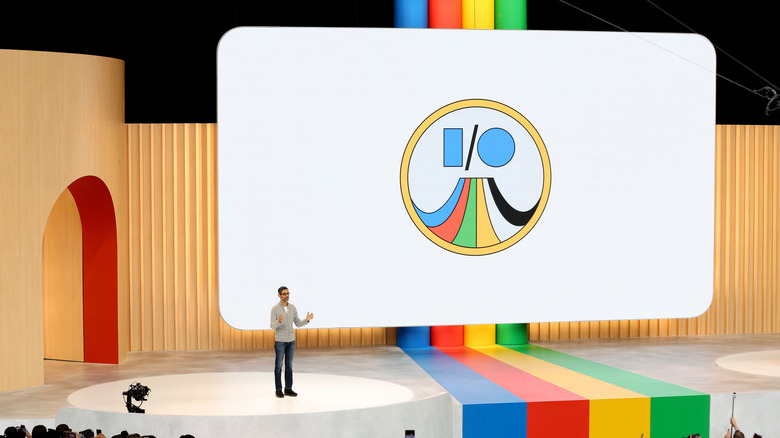
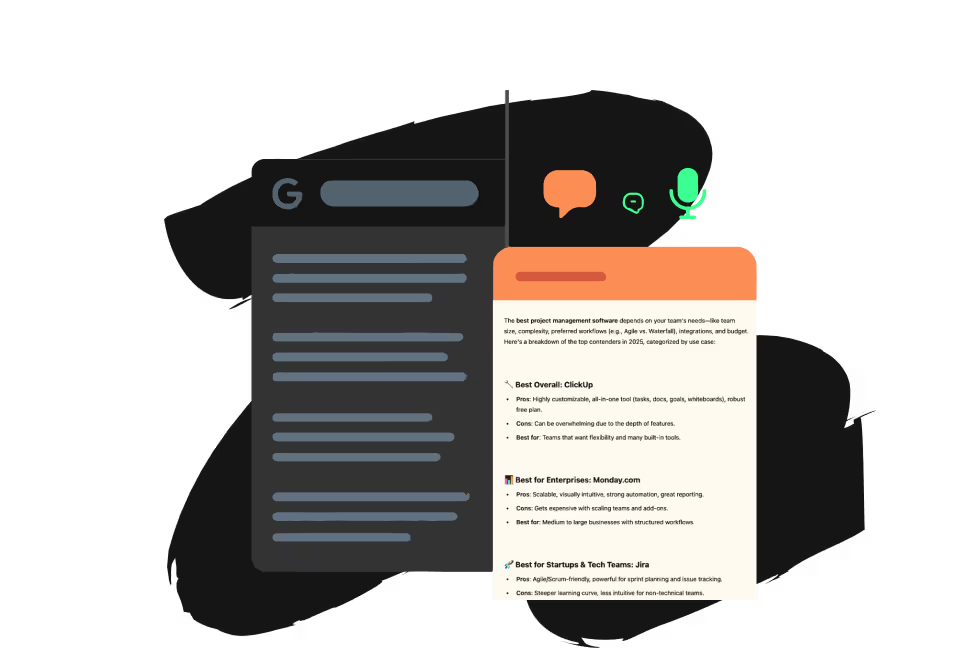
I sat through Google I/O 2026 last week and watched both camps quietly lose their argument. Because the most consequential thing Google said on that stage wasn't about Gemini 3.5 Flash, or AI Mode crossing a billion users, or the unified Search box being called "the biggest upgrade in over 25 years." The most consequential thing Google said was that AI search optimization isn't a new discipline. It's the same discipline. It's still SEO — Google just stopped pretending the line between "ten blue links" and "AI-generated answer with citations" was a line that mattered.
That has enormous implications for how SaaS and AI companies should be deploying their search budget right now. And almost none of those implications match what most agencies are selling.
Let me walk through what actually shipped, what Google's framing means strategically, and what we're doing at SimpleTiger to help our SaaS clients compound through this transition rather than get flattened by it.
The AI search section of the I/O 2026 keynote covered a lot of ground. Here's the short version, weighted by what actually matters for B2B and SaaS pipeline:
AI Mode is now the default surface — and it's massive. AI Mode crossed one billion monthly users, with queries doubling every quarter since launch. Gemini 3.5 Flash is now powering it as the default model. Last quarter, total Search queries hit an all-time high. The narrative that AI search is cannibalizing Google is true at the surface level and false at the business level — Google is absorbing the AI search experience, not losing to it.
AI Overviews and AI Mode have merged into one seamless experience. Google called this the biggest Search box upgrade in 25 years. You ask a question, you get a results page with an AI Overview, you can flow directly into AI Mode for a deeper follow-up — all in one continuous interface, on desktop and mobile, worldwide. The new Search box accepts text, images, files, videos, and Chrome tabs, and reasons across all of them.
Information Agents now run in the background of Search. Multiple agents per user, monitoring blogs, news sites, social posts, and "freshest data" like finance and shopping signals around topics you care about. This is Search becoming a persistent layer in the buyer's day, not a destination they have to remember to visit.
Generative UI and mini apps are coming to Search. Custom layouts, interactive visuals, tables, simulations, dashboards, trackers — Search will build the format that fits the question, on the fly. For complex evaluation queries (read: SaaS comparison shopping), this is going to fundamentally reshape what a SERP looks like.
Personal Intelligence is expanding worldwide. AI Mode with personal context — Gmail, Photos, Calendar connections — rolling out to nearly 200 countries and 98 languages with no subscription required.
Universal Cart and Universal Commerce Protocol are productizing the commerce layer of AI search, but I'll save the commerce implications for another piece.
Now here's the part that almost no one called out: every demo, every slide, every example flow Google walked through included the same quiet phrase — "with links to learn more." Citations are not an afterthought in this experience. They're the connective tissue. AI Overviews link out. AI Mode links out. Information Agents link out. The unified experience links out. Google is not building an answer engine that hoards traffic. They're building an answer engine that distributes attention to the brands and content it cites.
That distinction is the entire ballgame.
The thing that most marketing publications missed in their I/O 2026 recaps is the framing Google has been quietly hammering for the past 18 months — including in their public guidance to webmasters and their I/O developer sessions. Google does not consider "AI search optimization" a separate discipline. They consider it part of search engine optimization. The same crawl. The same index. The same E-E-A-T signals. The same relevance scoring. Just a different presentation layer on the output.
Information retrieval is information retrieval. Whether the retrieved information is presented as ten blue links, an AI-summarized overview, a conversational AI Mode dialogue, or a generative UI dashboard — the underlying job hasn't changed: surface the most relevant, authoritative, trustworthy content for a given query.
This matters because it tells you where Google is going to keep investing. They're not splitting their algorithm into "ranker" and "AI synthesizer" as separate roadmaps. They're building one retrieval system that serves multiple output formats. Which means the work you do to win in one format compounds in the others. Schema, entity authority, citation signals, structured content, link equity, technical foundation — those don't get traded for some new mythical "GEO tactic." They compound harder, not less.
The vendor-side narrative that "GEO is the new SEO" is doing real damage in the market right now. It's getting CMOs to authorize redundant budget lines for "AI search agencies" while their actual SEO program — which is what would have driven AI citations in the first place — gets defunded. It's getting marketing leaders to chase prompt-by-prompt optimization (which does have direct GEO/AEO impact, still) instead of building the entity authority and citation infrastructure that compounds across every AI surface.
Google said it directly at I/O 2026, and they've been saying it in their developer documentation for months: optimize for search, and AI search comes with it. The shift isn't from SEO to GEO. The shift is from narrow SEO (rankings, traffic) to total search visibility — rankings, AI citations, AI Share of Voice, and pipeline influence, treated as one system.
Here's where the rubber meets the road for SaaS and AI companies trying to generate pipeline in this environment.
For pure informational queries, AI Overviews and AI Mode are absolutely cannibalizing clicks. Organic CTR drops 61% when an AI Overview appears. Sixty percent of all Google searches end without a click — and inside AI Mode, that number is 93%. That trend is not reversing.
But for commercial-intent queries — the ones that actually move SaaS pipeline — the picture is very different. AI Mode and the unified AI Search experience still surface businesses, products, and brands as recommendations. They have to. Buyers asking "best customer success platform for mid-market," "alternatives to Gong," or "AI tools for content review" are doing commercial research, and the AI surfaces are designed to give them brands to consider, not just generic answers. Google has every commercial incentive to keep doing this — because that's where the ad inventory lives, and that's where the user gets actual value.
What's changed is how you become one of those recommended brands. You earn it the same way you've earned organic rankings for the last decade — but now the bar has gone up, because the AI is deciding which of the eligible brands to actually cite based on entity authority, content structure, citation signals from other authoritative sources, and your ongoing visibility across the open web.
Brands cited in AI Overviews see roughly 35% more organic clicks. They see up to 91% more paid clicks on the same queries. AI-referred traffic converts at roughly 5x the rate of traditional Google organic traffic — because users arrive pre-qualified by the AI's recommendation. None of those numbers are good news for brands that are invisible in AI answers. They're great news for brands that show up.
The economic logic is simple: being cited, mentioned, and linked to in AI-generated answers is now as important as ranking in position three on a SERP — and on most commercial queries, it's more important. Because the AI's mention is doing the prequalification work that the SERP used to require the user to do on their own.
When we rebranded around the Pipeline Engine model earlier this year, the entire premise was that SaaS and AI companies need one connected program — Demand Creation, Demand Capture, Demand Nurture, all measured against pipeline and revenue — instead of the channel-by-channel retainers most agencies are still selling.
The AI search transition is the clearest possible validation of that thesis. Companies that try to bolt "GEO" onto an existing SEO program as a separate workstream end up with conflicting strategies, double-paid budgets, and content that's not optimized for either surface. Companies that treat Search Visibility (SEO + GEO) as one workstream — same content, same entity strategy, same authority program, same technical foundation, with measurement that includes AI Share of Voice alongside traditional rankings — compound on every surface Google ships next.
Concretely, what that looks like in practice: we audit and structure sites so they're eligible to rank in Google and be cited by LLMs (schema, entity markup, llms.txt, structured FAQs, comparison content built for dual indexing). We track AI Share of Voice across ChatGPT, Claude, Gemini, Perplexity, and Google AI Overviews on a prompt-by-prompt basis alongside traditional keyword rankings. We coordinate link building and digital PR around both backlink equity and unlinked brand mention signals, because unlinked mentions now correlate with AI visibility roughly as strongly as backlinks correlate with Google rankings. And we tie all of it to pipeline attribution — qualified opportunities and revenue, not sessions and impressions.
We ran this exact playbook with Invoca over the last year. The result was 22.5% AI search share of voice (category leadership), $500K+ in revenue directly attributed to AI search, and $3M+ in total organic-influenced revenue with a 41:1 ROI — all from one integrated program, not a separate AI search line item. That's what compounding visibility across both surfaces actually looks like when it's treated as one engine instead of two.
The brands that are going to dominate their SaaS categories over the next 24 months are the ones that take Google at their word right now. Search is one discipline. AI search is search. Treat your SEO and GEO investment as one compounding program — strategically, operationally, financially — and you build category authority that gets harder to displace every month. Treat them as separate, and you'll spend twice as much to win half as often.
If you want to stay close to how this landscape is shifting in real time, The AI Search Report is where we publish what we're seeing across our client portfolio and the broader market every month — citation patterns, AI Share of Voice movement, ranking shifts, what's compounding and what's not. It's the fastest way to stay current on this without having to read 100-item I/O recaps.
If you want to see what a SimpleTiger Pipeline Engine would look like for your specific business — including a baseline of where you currently appear in AI-generated answers for your category and what it would take to move that — book an Opportunity Assessment. We'll map your traditional search visibility, your current AI search footprint, your category competitors' positioning, and the specific opportunities to take share before the rest of the market catches up to what Google just said on stage.
The line between SEO and AI search is gone. The line between the brands that compound through this transition and the brands that don't is forming right now.

Sean is Chief Strategy Officer at SimpleTiger, leading strategic direction & overarching marketing strategy for SimpleTiger clients. Sean's also responsible for navigating the shift from a traditional SEO focus to an AI search-first focus in the B2B SaaS and AI software industry & furthering our position as an industry leading digital marketing agency focused on rapid growth for our clients through search..
Over 60+ pages detailing how to grow your SaaS company using a proven SEO process.
Actionable insights to help you grow your SaaS and dominate your search market!









.avif)