SaaS product marketing shows customers why a product matters by translating features into outcomes.
Because SaaS revenue depends on retention, marketing must focus on long-term value—not one-off sales.
Strong positioning and messaging help buyers quickly grasp what the product does and why it’s useful.
SEO, content, email, and other lifecycle tactics attract new users and move them through each stage of the journey.
Teams that test, measure, and stay aligned grow faster and avoid wasted effort.
The SaaS market is growing quickly. According to Fortune Business Insights, it was worth $266 billion in 2024 and is projected to reach $1.13 trillion by 2032.
Yet many SaaS companies struggle to scale.
Because the SaaS revenue model is different from other businesses, success requires a focused product marketing strategy.
Keep reading to learn:
What SaaS product marketing is
Who manages it
How it works
Strategies to grow in a competitive market
Steps to build and improve your plan
What Is SaaS Product Marketing?
SaaS product marketing defines a product’s message, position, and go-to-market strategy. It helps potential buyers understand why the product is valuable.
The main goals are to:
Create demand
Drive adoption
Keep users engaged
It connects what the product does with what customers need, leading to stronger growth and higher retention.
Key Components of SaaS Product Marketing
Positioning and messaging: Explain what makes the product valuable and unique.
User acquisition and adoption: Reach new users and help them see value quickly.
Customer retention and growth: Keep customers engaged and encourage renewals or upgrades.
Lifecycle marketing: Guide customers from awareness to long-term loyalty.
SaaS Product Marketing vs. Traditional Marketing
Traditional marketing focuses on one-time sales. SaaS marketing focuses on long-term relationships and subscriptions.
SaaS teams track adoption, retention, and customer lifetime value (LTV) to measure success.
The table below highlights the key distinctions between the two approaches.
Aspect
SaaS Product Marketing
Traditional Marketing
Business model
Recurring subscription revenue
One-time or transactional sales
Customer focus
Retention, expansion, LTV
Acquisition and first purchase
Marketing objective
Drive adoption & reduce churn
Generate quick sales and short-term revenue
Customer lifecycle
Ongoing (awareness → advocacy)
Linear (ends after purchase)
Core metrics
MRR, CAC, LTV, churn, adoption
Sales volume, profit margin, market share
Feedback loops
Real-time, behavior-driven
Slower, survey or sales-based
Team collaboration
Product + sales + CS + marketing
Mostly marketing and sales
Value communication
Ongoing product value & ROI
Persuades to first purchase
Customer relationship
Continuous engagement and support
Often ends after purchase
Who Owns Product Marketing in SaaS?
SaaS product marketing sits between product, marketing, and sales. It helps turn product value into growth by:
Aligning go-to-market strategy, messaging, and customer insights
Turning technical features into clear, customer-focused benefits
Keeping teams aligned with a shared value story
Collaboration is essential. Product marketing works closely with other departments to keep messaging consistent from development to customer adoption.
Product Marketing as a Role
Product marketing is usually led by a product marketing manager (PMM)—a strategist who connects teams.
A 2024 McKinsey and Company report found that companies with PMMs grow faster than those without them.
A PMM typically:
Ensures every launch and campaign reflects customer needs
Conducts market and competitor research
Creates messaging frameworks and sales materials
Manages launches and cross-team campaigns
Uses customer data to improve strategy
As companies grow, product marketing often expands into a team with roles like:
Content specialist: Creates case studies, product pages, and thought leadership pieces.
Sales enablement specialist: Builds tools and training for sales teams.
Analytics specialist: Tracks performance and uncovers opportunities.
Want to learn the fundamentals of SaaS marketing?
See how effective content and SEO strategies turn awareness into predictable growth.
Optimize continuously. Monitor cost-per-click (CPC), click-through rate (CTR), and cost-per-acquisition (CPA). Use these to refine performance and improve ROI.
4. Email Marketing
Email builds relationships and keeps users engaged. It’s a direct way to guide customers through their journey.
Best practices:
Segment strategically. Group contacts by behavior, company type, or lifecycle stage.
Automate key sequences. Build workflows for onboarding, product adoption, renewals, and re-engagement.
Focus on education. Share practical tips, use cases, and product insights, not just promos.
Use analytics to refine. Measure engagement, click rates, and revenue attribution. Use these to improve content and strategy over time.
5. Social Media Marketing
Social media builds trust and community. It’s a space to share updates and connect authentically with users and potential customers.
Best practices:
Share value-driven insights. Combine product updates with thought leadership and customer stories.
Encourage engagement. Participate in conversations, respond to comments, and celebrate customer wins.
Adjust messaging for each platform. Use LinkedIn for B2B education, X (Twitter) for discussion, and YouTube or TikTok for visual storytelling.
Track meaningful metrics. Prioritize engagement quality over vanity metrics like impressions.
6. Video Marketing
Video marketing makes your product easier to understand and builds confidence.
Best practices include:
Use diverse formats. Create explainers, demos, testimonials, and training videos.
Keep it concise. Focus on showing real value, not listing features.
Embed everywhere. Add videos to landing pages, emails, and social media posts. This increases engagement and conversion.
Measure success. Track completion rates, watch time, and conversions. Use these metrics to guide your video strategy.
7. Webinars and Live Events
Webinars and live events like workshops and product demos let you teach, connect, and build community around your product. They’re especially effective for complex or B2B products.
Best practices include:
Educate first, sell later. Solve industry problems and showcase best practices.
Collaborate with experts. Co-host events with partners or influencers to expand reach.
Follow up immediately and effectively. Share recordings, resources, and next steps after the event.
Repurpose content. Convert webinars into shorter videos, blog summaries, or guides for long-term use.
Need help building a stronger SaaS marketing engine?
At SimpleTiger, our SaaS SEO expertise, proprietary AI tools, and proven frameworks can quickly strengthen your SEO, PPC, and web performance.
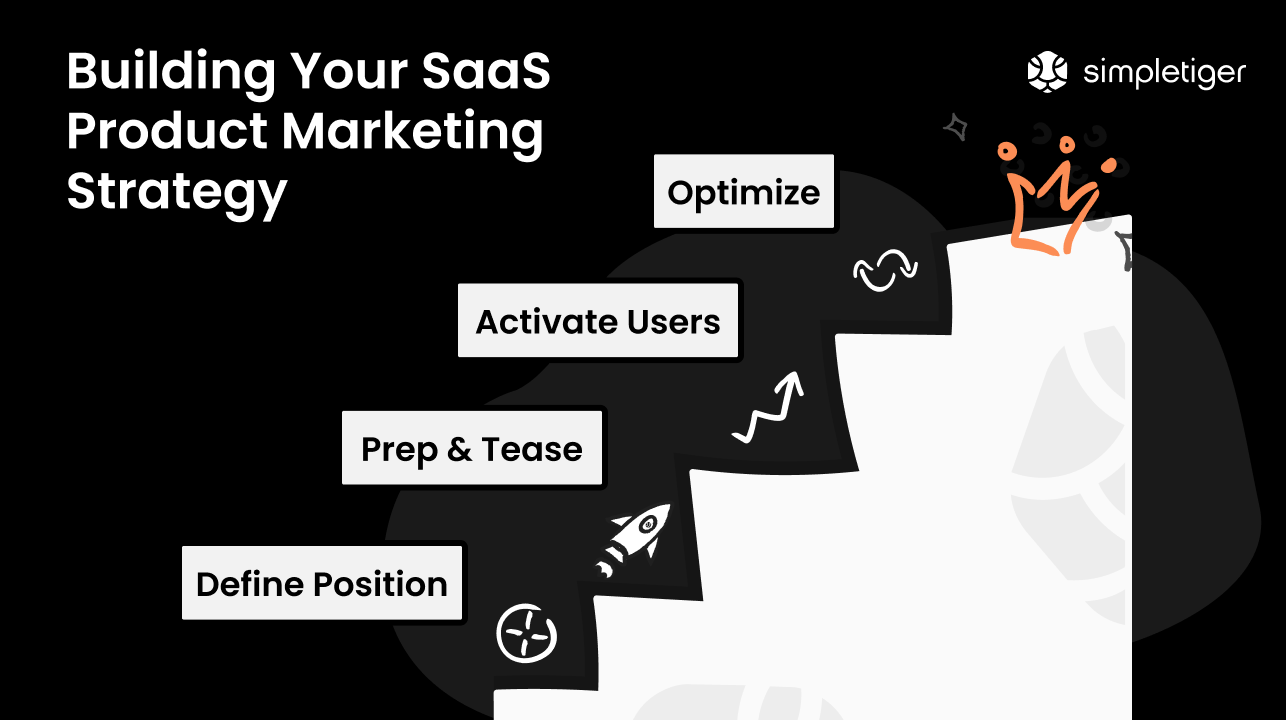
A strong marketing product strategy gives you a roadmap for growth. Here’s how to structure it:
1. Define Your Market Position and Ideal Customer
Before you create campaigns, you need to know where your product fits in the market and who it’s built for.
This ensures every message resonates with the right audience and supports your growth goals.
Key components:
Value proposition: What your product delivers and how it helps your customers.
Differentiation: What makes your product unique.
Target audience: The user types that gain the most value from your solution.
Customer insights: Which traits, pain points, and motivations your best customers share.
Validation: Data from sales, product, and customer success teams that help you refine strategy.
2. Plan Your Pre-Launch Activities
Before launching a new product or feature, build anticipation and gather early feedback.
A strong pre-launch phase helps you:
Validate your messaging
Identify adoption barriers
Prepare your internal teams for success
Pre-launch activities:
Beta testing: Collect insights from a select group of target users.
Teaser campaigns: Use landing pages, social previews, and email sequences to generate interest.
Team enablement: Train sales and support teams on messaging, positioning, and FAQs.
Early access programs: Reward engaged users with priority access to your product.
3. Drive Post-Launch Growth
After launch, focus on product adoption, customer retention, and optimization.
Use feedback and user data to refine your marketing strategy and strengthen your product-market fit.
Post-launch tactics:
Targeted onboarding campaigns: Help users get quick wins with guided setup and personalized tips.
Ongoing education: Drive deeper engagement through webinars, tutorials, and in-app messaging.
Feedback loops: Improve your product and strategy using input from customers and internal teams.
Data analysis: Identify friction points and optimization opportunities through early-adoption trends.
4. Measure and Optimize Continuously
SaaS marketing is an iterative process. What works today may not work next quarter.
Continuous optimization aligns strategy with changing market conditions, customer needs, and performance data.
How to keep improving:
Review metrics regularly. Track key performance indicators like activation rate, MRR, CAC, and churn.
Run experiments. Test different messages, creative assets, and funnel paths. Find incremental gains that compound.
Leverage customer insights. Use feedback from sales and customer success teams to refine positioning and content.
Update documentation. Keep your internal playbooks, messaging guides, and campaign data current. This enables you to pivot as the market evolves.
Tips to Scale SaaS Product Marketing
Scalable growth requires systems that amplify what's working, without adding unnecessary complexity or cost.
Automate Core Workflows
Connect your CRM, analytics, and product data. This will eliminate repetitive tasks and maintain consistency.
Use automation to trigger lifecycle campaigns (like onboarding or re-engagement). Generate real-time dashboards with it, so your team focuses on strategy, not manual reporting.
Reinvest in Proven Channels
Identify which channels, campaigns, and content deliver the best ROI. Then double down on them.
Refine messaging and creative assets for steady, compounding gains:
Reallocate budget.
Repurpose top assets into new formats.
Run small A/B tests.
Build Smart, Aligned Teams
Growth depends on clarity and collaboration. To get this:
Document workflows, messaging, and KPIs to sync marketing, product, sales, and customer success.
Hold regular, cross-functional meetings to share feedback and keep strategy aligned.
Outsource execution-heavy or technical tasks to maintain agility.
Partner with Experts
Partnering with experts:
Accelerates execution
Reduces trial-and-error
Helps internal teams stay aligned
Helps you scale faster
Work with a SaaS-focused agency that can apply proven frameworks for SEO, content, and paid acquisition.
Ready to scale your SaaS growth?
See how SimpleTiger helps SaaS teams turn strategy into real results.
Learn from the example of leading SaaS companies. Each of the following brands has seen massive growth through expert product marketing.
Notion
Notionuses a product-led growth model built on simplicity and accessibility. Its free tier and template library let users experience value instantly. This reduces friction and showcases flexibility across use cases.
Notion’s community-driven marketing and real user stories foster adoption and advocacy.
Slack
Slackuses clear messaging, deep integrations, and an easy interface. Its invitation-based onboarding turns every new user into an advocate. This fuels rapid, bottom-up adoption.
By emphasizing productivity and human connection, Slack makes communication feel effortless.
HubSpot
HubSpot popularized inbound marketing by leading with education and trust. They offer free content, templates, and tools that attract marketers early in their journey.
HubSpot’s marketing positions the platform as a complete solution for marketing, sales, and service. This emphasizes measurable ROI, which is key for growth.
Take the Next Step Toward Predictable Growth
Effective SaaS product marketing drives growth by connecting product value to customer needs.
We combine proven strategies with proprietary AI technology to accelerate your growth.
Our approach focuses on the 20% of your actions that yield 80% of your results, so you scale faster and waste less.
We identify untapped opportunities and fill gaps in your strategy.
Our data-driven approach ensures measurable business outcomes.
Ready to turn your SaaS product marketing into a predictable growth engine?Book a discovery call and see how we can help you excel, no matter your size or specialty.
FAQs
What is the 3-3-2-2 rule of SaaS?
What is the job description of product marketing in SaaS?















.avif)
.avif)